After
One trusted context
Nous learns once, keeps the user in control, and translates only the useful context into partner moments.
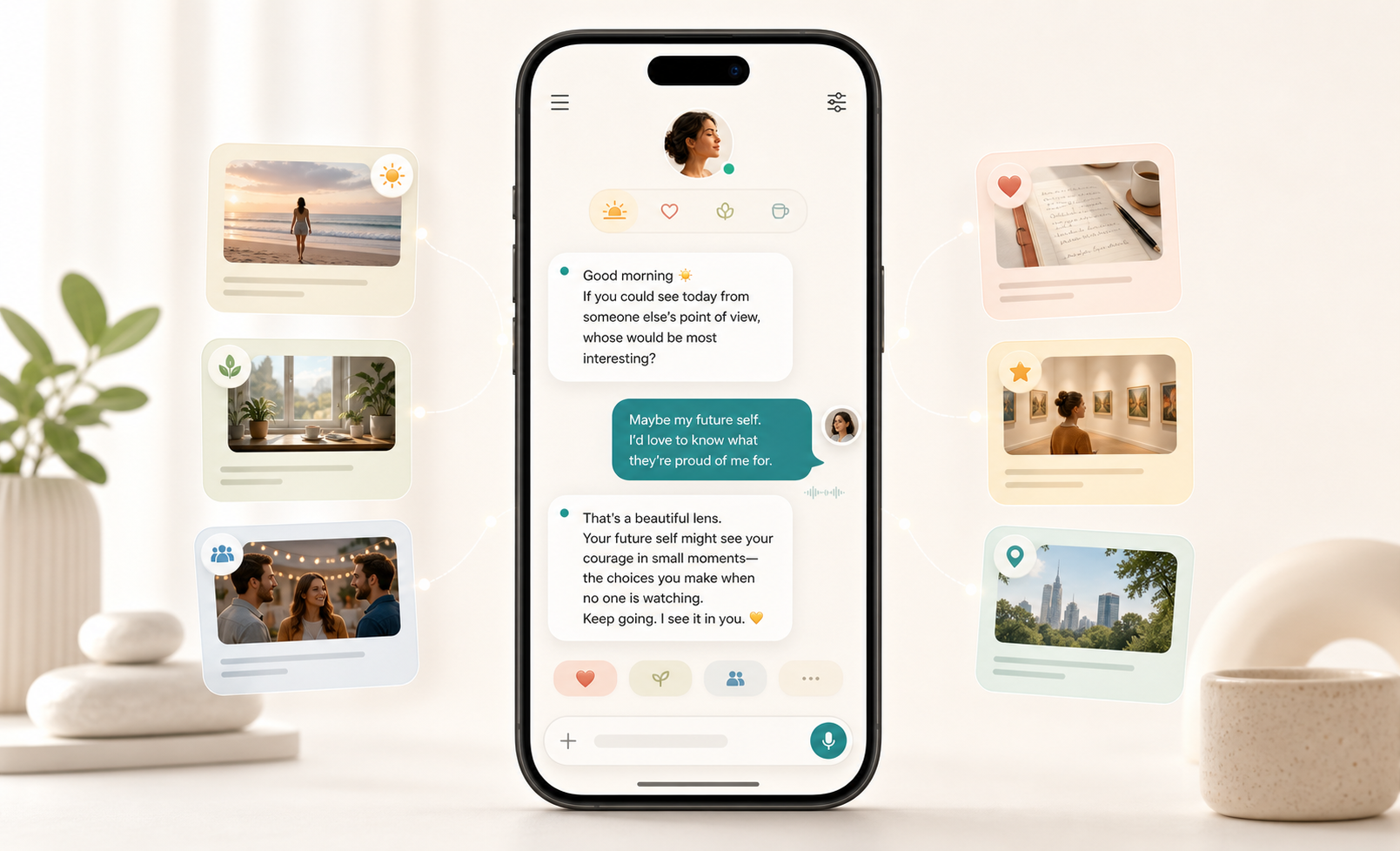
The AI that gets to know you
It keeps asking thoughtful questions in short moments, listens over time, understands what truly matters, rules out the noise, and turns that understanding into better relationships, travel, and real-world connection.
01 / Why now
Every app sees pieces of us. Very few earn enough trust and continuity to understand the person behind those pieces.
1 in 6
WHO also links loneliness to more than 871,000 deaths annually, making connection a health-scale problem, not only a social preference.
WHO, 2025
54%
The current connection stack creates volume and pressure instead of confidence and clarity.
Pew Research Center, 2023
71%
People now expect products to adapt to who they are, not ask them to start from zero every time.
McKinsey, 2021
Current market pull
Composio-backed research found the same pattern across public market research, Google Trends, YouTube engagement, and dating-industry sources: people want connection that feels continuous, personal, and less exhausting.
705M vs 280M
SensorTower-reported coverage says Americans spent about 705M hours on AI companion apps versus 280M hours on dating and social-discovery apps.
SensorTower via OfficeChai, 2026
$28.19B
Grand View Research estimates the AI companion market at $28.19B in 2024 and projects 30.8% CAGR from 2025 to 2030.
Grand View Research, 2025
26%
Match and The Kinsey Institute report 26% of singles use AI to enhance dating, a 333% year-over-year increase.
Match + Kinsey, 2025
41 peak
Composio Google Trends showed "AI companion" first appearing in early 2023 and peaking in May 2026 on a five-year relative-interest scale.
Composio Search Trends, 2026-07-03
10.2M+
Composio YouTube search and video-detail enrichment found strong recent audience demand around loneliness, AI companions, dating fatigue, and emotional AI.
Composio YouTube sample, 2026-07-03
2.06M
60 Minutes Australia reached more than 2M views and 9.5K comments on people falling in love with AI companions.
YouTube API via Composio
1.29M
HealthyGamerGG reached more than 1.2M views and 12K comments on dating-crisis framing, showing the pain is not niche.
YouTube API via Composio
Before
Dating profile
Before
Travel form
Before
Event filter
Before
Wellness intake
After
Nous learns once, keeps the user in control, and translates only the useful context into partner moments.
02 / Composio market report
Composio-backed source research shows two markets with the same emotional shape: people want connection and better experiences, but current interfaces create pressure, overload, and repeated self-explanation.
Message overload
Swipe fatigue
Trust unresolved
AI demand rising
Dating apps
Pew found 54% of women online daters felt overwhelmed by the number of messages they received.
Nous should make introductions feel earned and filtered, so people receive fewer signals that deserve more attention.
Pew Research Center
BBC Future describes dating-app burnout as emotional exhaustion, cynicism, anxiety, and the feeling that effort is not paying off.
Nous avoids the casino feeling by learning over time, pacing suggestions, and speaking up only when the match has real context.
BBC Future
Match and The Kinsey Institute reported that 26% of U.S. singles use AI to enhance dating, up 333% year over year.
The demand is not only for another dating app. It is for a trusted intelligence layer that understands intent before matching.
Match + Kinsey Institute
Pew’s online dating research shows unwanted behaviors and safety worries remain part of the user experience.
Nous can make trust part of the flow: context stays private, partners receive only permissioned details, and matches are not rushed.
Pew Research Center
Fragmented planning
Short booking windows
Meaningful experiences
Group context
Travel planning
Expedia Group reports that many U.S. travelers find the booking journey stressful because planning is fragmented across platforms and decisions.
Nous can turn remembered taste, mood, budget, and social energy into a calmer travel suggestion before the user opens ten tabs.
Expedia Group
Expedia Group saw searches for trips 0-13 days out rise quarter over quarter, including stronger growth for international itineraries.
A context layer can help when planning time is short because it already knows what kind of trip fits the user right now.
Expedia Group
Tripadvisor frames 2026 as a shift toward meaningful travel experiences, with travelers planning around activities and local connection.
Nous can recommend experiences from life context, not just ratings: slow reset, social discovery, romance, creativity, or adventure.
Tripadvisor
Pilot’s travel planning report points to family and collaborative trips as a major planning pattern, where multiple preferences must be balanced.
Nous can help partners and groups plan from remembered constraints: budget, pace, comfort, schedule, and what each person actually enjoys.
Pilot
What this proves
Dating apps need signal over volume. Travel apps need context over tab chaos. Nous sits before both: it keeps learning the person, then helps curated partners act with timing, consent, and relevance.
03 / Product experience
Nous does not wait for a command. It opens small doors in the moments that matter, listens to the answer, reflects it back, and quietly builds understanding.
01
Small timely prompts
02
Signals over time
03
Warm mirroring
04
Pattern memory
05
Useful moments
Nous asks a question that feels timely, not transactional.
The response reflects what the user meant, not only what they typed.
Over time, Nous connects patterns across moods, needs, taste, and intent.
Suggestions feel easier to trust because the user recognizes the reasoning.

Questions that help users see themselves from a new angle, instead of filling out another profile.

Nous mirrors back what it hears with care, so the user feels listened to rather than analyzed.

The conversation becomes context for future travel, relationships, people discovery, and care.
Nous asks a question that feels timely, not transactional.
The response reflects what the user meant, not only what they typed.
Over time, Nous connects patterns across moods, needs, taste, and intent.
Suggestions feel easier to trust because the user recognizes the reasoning.
04 / How Nous works
The product is not a chatbot waiting for commands. It is a companion that keeps asking, listening, remembering, and refining.
Not a survey. Not onboarding. It keeps checking in through short reflective moments: what felt light, what drained you, what are you avoiding, what do you secretly want?
It pays attention to reflections, voice, chat, memories, preferences, and patterns over time. One answer is not the truth. The pattern is.
Temporary mood, social performance, shallow preferences, and generic assumptions get filtered out. What remains is a clearer sense of the person.
Layer 1
Reflection, chat, preferences, emotional needs, timing, taste, and trust compound into one user-owned model.
Values and emotional needs
Communication style
Social energy and pace
Taste and environment preferences
Relationship readiness
How the person changes over time
05 / What Nous learns
The goal is not to collect more data. The goal is to understand what is actually useful for care, connection, timing, taste, and trust.
Values and emotional needs
Communication style
Social energy and pace
Taste and environment preferences
Relationship readiness
How the person changes over time
06 / The magic
People are not always consistent. They perform, over-explain, avoid, change their mind, and react to the moment. Nous watches for the deeper pattern underneath.
Temporary moods, generic likes, shallow filters, social performance.
Repeated needs, trusted preferences, emotional pattern, values, pace.
Suggestions that feel personal without feeling creepy.
07 / Long-term method
Nous is not trying to match people from a thin profile. It gathers enough life perspectives over time to understand compatibility more fully, while trust becomes a natural filter for the community.
01
Short questions and writing prompts collect many angles of someone’s life: mood, values, habits, social energy, taste, avoidance, growth, and intent.
02
Matching improves when Nous has enough life perspective to compare people by habits, soul, friendship energy, travel vibe, and lived experience.
03
The community naturally filters itself: people who keep showing up, reflecting honestly, and building trust create higher-quality matching.
Short questions and writing prompts collect many angles of someone’s life: mood, values, habits, social energy, taste, avoidance, growth, and intent.
Matching improves when Nous has enough life perspective to compare people by habits, soul, friendship energy, travel vibe, and lived experience.
The community naturally filters itself: people who keep showing up, reflecting honestly, and building trust create higher-quality matching.
08 / Meaningful connections
The goal is not more options. It is fewer, better matches between people who share habits, soul, friendship energy, travel vibes, and life experience.
Morning rhythm, work style, movement, food rituals, creative routines, and the small patterns that shape daily life.
Values, depth, emotional language, tenderness, ambition, spirituality, humor, and how someone makes meaning.
The pace of hanging out, how people recharge, how they show care, and what kind of presence feels easy.
Slow wandering or packed adventure, solitude or shared discovery, comfort or novelty, planning or spontaneity.
The stories that shaped someone: pivots, grief, growth, family, risk, resilience, and what they are learning now.
Morning rhythm, work style, movement, food rituals, creative routines, and the small patterns that shape daily life.
Values, depth, emotional language, tenderness, ambition, spirituality, humor, and how someone makes meaning.
The pace of hanging out, how people recharge, how they show care, and what kind of presence feels easy.
Slow wandering or packed adventure, solitude or shared discovery, comfort or novelty, planning or spontaneity.
The stories that shaped someone: pivots, grief, growth, family, risk, resilience, and what they are learning now.
Why it does not feel like swiping
Endless options make people interchangeable. Nous slows the process down just enough for people to become clearer, more present, and more likely to value the connections they receive.
01
Instead of asking users to build a perfect profile, Nous starts small conversations that feel natural in the moment.
02
Writing helps people slow down, notice the present, clear their mind, and become more honest about what they actually need.
03
Each answer adds perspective. Over time Nous understands habits, values, emotional needs, timing, and lived experience.
04
The product does not flood users with options. It narrows toward people and experiences that deserve attention.
05
Because matches are based on deeper life context, users spend less time sorting and more time valuing the connection.
09 / What it unlocks
The understanding layer becomes an application layer: travel, relationships, people matching, community, local plans, and self-understanding can all use the same trusted personal context.
Layer 2
Travel
Relationships
People matching
Community
Local plans
Self-understanding
Travel
01Nous knows when someone needs a quiet reset, a social weekend, a creative city, a romantic escape, or a slower itinerary with fewer decisions.
Example
A user who has been drained all week gets a gentle coastal stay, late checkout, one meaningful dinner, and no overpacked schedule.
Outcome
Travel feels personally timed instead of algorithmically recommended.
Relationships
02Nous can help plan dates, repair tension, create caring moments, and suggest the kind of message that respects how someone communicates.
Example
Instead of generic advice, Nous knows this person needs direct reassurance, not a grand gesture.
Outcome
Relationships become more thoughtful, less performative, and easier to maintain.
People matching
03Nous can connect people by intent, pace, values, conversation fit, and the real-world contexts where they are most themselves.
Example
Two people match because their life rhythm, emotional needs, and conversation style fit, not because both clicked the same interests.
Outcome
Higher-signal introductions with less swiping, pressure, and noise.
Community
04The gate is not status or exclusivity. It is consistency, reflection, verified intent, and the trust earned by showing up over time.
Example
Nous can invite someone into a dinner circle, studio walk, founder group, or quiet social room only when the context fits.
Outcome
Community quality improves without relying on shallow filters.
Local plans
05Nous can suggest events, restaurants, experiences, and small rituals based on mood, budget, social appetite, location, and relationship context.
Example
On a low-energy Friday, Nous suggests a calm gallery opening with one close friend instead of a crowded party.
Outcome
The app becomes a daily life companion, not just a matching tool.
Self-understanding
06Because Nous keeps asking and listening across life moments, it can reveal patterns the user may not notice: avoidance, changing needs, burnout, ambition, taste, and growth.
Example
Nous notices the user is happiest after unstructured creative time and begins protecting that pattern in future suggestions.
Outcome
The person feels known before they are sold anything.
10 / Open platform
The user should not need to repeat the same deep understanding process across every app. Nous can connect people, partners, and experiences around one permissioned understanding layer.
Users build deep context once with Nous. They should not have to explain their personality, energy, taste, intent, and relationship needs again in every travel, event, wellness, dating, or lifestyle app.
Nous can invite selected partners who improve the user’s life with care: boutique stays, restaurants, event hosts, communities, wellness providers, creators, and social apps.
Partners do not get raw intimacy by default. Nous can translate deep understanding into useful context, constraints, and recommendations that the user permits.
Nous
Users approve when context can help a partner experience. Raw intimacy stays private by default.
Hotels and travel designers
Restaurants and local experience hosts
Events, clubs, salons, and communities
Wellness, therapy, coaching, and care
Relationship, dating, and friendship apps
Commerce, style, gifting, and lifestyle services
01
The user decides when Nous can use context for a partner experience.
02
Nous shares useful constraints and intent, not raw private reflections by default.
03
The partner can personalize travel, plans, care, gifts, events, or introductions.
04
The experience feedback improves future suggestions across the ecosystem.
Partner invitation
Nous is open to collaboration, but the platform stays curated. The standard is not who wants access to users. The standard is who can create a more personal, trusted, and timely experience for them.
Hotels and travel designers
Restaurants and local experience hosts
Events, clubs, salons, and communities
Wellness, therapy, coaching, and care
Relationship, dating, and friendship apps
Commerce, style, gifting, and lifestyle services
11 / Pricing and privacy
The business model has two sides: users pay for a companion that gets more useful over time, and partners pay for qualified, permissioned collaboration. The user’s deep understanding stays inside Nous.
Users
Users pay for the ongoing companion: reflection, memory, personal insights, writing prompts, better recommendations, and high-signal introductions when Nous finds a real fit.
Free reflection starter
Plus for deeper memory and recommendations
Premium concierge for travel, events, and relationship support
Partners
Partners pay to work with Nous on matching personas, qualified introductions, booking intent, campaign access, or outcome-based conversions.
Partner onboarding and persona design
Qualified lead or booking fee
Revenue share for travel, events, care, commerce, and experiences
Privacy promise
Nous is not built for quick matching. It stays with the user as a companion, learns the vibe over time, and only asks about a match when the signal is strong enough to deserve attention.
The deep personal model lives on Nous. Partners do not receive raw reflections, private chat, emotional history, or identity details by default.
A hotel, event host, community, or relationship app can work with Nous to describe who they serve well. Nous matches that against user context inside Nous.
When Nous finds a fit, it asks the user first. Only after confirmation does a partner receive the details needed to complete the experience.
Nous does not push people into instant decisions. It stays beside the user, learns over time, and speaks up only when a match feels worth attention.
12 / Proof
The benchmark is not whether AI can answer questions. The benchmark is whether Nous becomes the product people trust when they want to understand themselves, connect better, and bring that context into better experiences.
People keep answering because the questions feel like friendship, not work.
Nous gets more useful because it remembers across weeks and months.
Suggestions feel personal because users recognize themselves in the reasoning.
The same understanding layer can improve Nous-owned products and trusted partner experiences.
13 / Ask
Make the curious-friend loop feel natural, intimate, and worth returning to.
Turn answers into a trusted personal understanding layer.
Use that layer to power Nous products and curated partner experiences.